



① Quick Answer
Mobile (vehicle-mounted) radios operate on 13.8V DC vehicle power to deliver 25 to 75 W of continuous RF output through high-gain external roof antennas, achieving 30 to 80 km of reliable communication range for transportation fleets, heavy machinery, and dispatch base stations. In contrast, portable handheld walkie talkies provide 5 to 10 W output with internal lithium-ion batteries, designed for on-foot mobility, warehouse aisles, and site security. For most commercial operations, the optimal strategy is not choosing one over the other, but deploying a unified mixed fleet where vehicle-mounted mobile stations coordinate seamlessly with ground-crew handheld transceivers on shared frequencies and CTCSS squelch codes.
② Key Takeaways
- RF Transmission Power Disparity: Mobile radios produce 25–75 W of RF output (5 to 15 times more powerful than 5–10 W handhelds), delivering 3 to 5 times greater operational range across open terrain and highway corridors.
- Continuous Duty Cycle & Power Architecture: Mobile transceivers connect directly to vehicle 12V/24V battery systems via heavy-duty DC harnesses and feature cast-aluminum heat sinks for 100% duty-cycle dispatch, eliminating handheld battery depletion anxiety.
- Antenna Efficiency & Ground Plane: External vehicle-roof whip antennas utilize the vehicle's metal chassis as an RF ground plane, achieving near-perfect 50-ohm impedance matching and superior line-of-sight propagation compared to flexible rubber duck handheld antennas.
- Direct Fleet Interoperability: Mobile radios and handheld walkie talkies communicate with each other seamlessly provided they share identical frequency channels, modulation bandwidth (12.5 kHz narrowband), and matching CTCSS/DCS sub-audible privacy codes.
- Turnkey Factory Synchronization by QYT: QYT Electronics manufactures both high-power mobile transceivers (such as the KT-8900 and KT-980Plus) and rugged handhelds (such as the KT-8R), supplying pre-synchronized channel tables, OEM branding, and international regulatory clearance directly from the factory.

③ Core Technical Guide (Google PAA Search Intent)
What Is the Difference Between a Mobile Radio and a Handheld Walkie Talkie?
Conclusion: The fundamental difference between a mobile radio and a handheld walkie talkie lies in RF power output, power supply architecture, antenna efficiency, and physical thermal dissipation.
Engineering Comparison & Operating Parameters:
-
RF Power Amplification & Range:
- Handheld Radios: Handheld transceivers are limited to 4 to 10 W RF output to preserve battery life and adhere to Specific Absorption Rate (SAR) human RF exposure standards. In direct line-of-sight conditions, 5 W handhelds achieve reliable coverage between 3 and 10 km.
- Vehicle-Mounted Mobile Radios: Mobile transceivers utilize heavy-duty RF power amplifier modules (such as those in the QYT KT-8900 rated at 25 W VHF/20 W UHF, or the QYT KT-980Plus delivering 75 W VHF/55 W UHF). High-power mobile units push clear voice signals 30 to 80 km across open terrain, coastal waters, and rural transit routes.
-
Power Source & Continuous Operation:
- Handheld Radios: Powered by 7.4V lithium-ion battery packs (typically 1,500 to 3,000 mAh), providing 8 to 16 hours of operation under standard 5-5-90 duty cycles (5% transmit, 5% receive, 90% standby). Heavy transmission duty drains handheld batteries rapidly.
- Mobile Radios: Draw power directly from a vehicle's 12V or 24V electrical bus (operating at nominal 13.8V DC ±15%). Mobile units operate indefinitely while the engine is running or when connected to a 13.8V DC desktop power supply in a command shack.
-
Antenna Systems & Radiation Efficiency:
- Handheld Radios: Use shortened, flexible helical antennas ("rubber ducks") with compromised radiation efficiency (negative gain, typically -2 to 0 dBi) due to physical size limitations.
- Mobile Radios: Connect via low-loss 50-ohm coaxial cables to external vehicle-roof or mast-mounted whip antennas. Mounted on a metallic vehicle roof, the vehicle body acts as a massive RF ground plane, achieving positive gain (+3 to +6 dBi) and an omnidirectional radiation pattern.
-
Chassis & Thermal Management:
- Handheld Radios: Engineered with lightweight polycarbonate enclosures to facilitate pocket or belt carry (weighing 150 to 300 g).
- Mobile Radios: Constructed inside heavy-duty die-cast aluminum heat-sink chassis (weighing 1,000 to 1,500 g) equipped with cooling fins and thermostatically controlled fans, allowing sustained, high-power transmission without thermal shutdown.
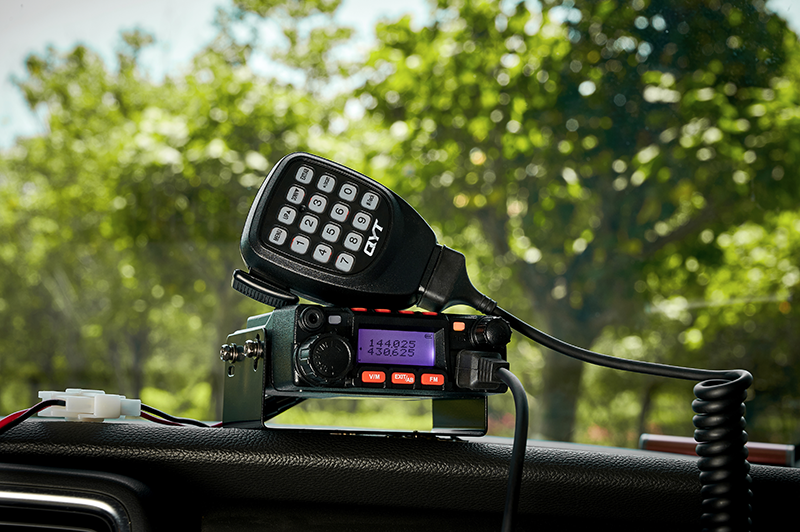
Product Reference: The QYT KT-8900 is an ultra-compact dual-band commercial mobile transceiver delivering 25 W VHF and 20 W UHF output. Featuring a rugged cast-aluminum chassis, front LCD screen, and heavy-duty DTMF microphone, it serves as the primary mobile communication hub for commercial logistics fleets and dispatch desks.
When evaluating equipment for large organizations, exploring the QYT Two-Way Radio and Mobile Transceiver Catalog allows procurement directors to source commercial radios equipped with industry-standard 2-pin programming interfaces and factory programming support.
When Should I Choose a Vehicle-Mounted Radio Over a Handheld?
Conclusion: Choose a vehicle-mounted radio when your operational personnel are seated in commercial vehicles, marine vessels, or fixed offices, and when required coverage exceeds 15 km; choose a handheld when operators require complete untethered on-foot mobility.
Commercial Decision Tree:
-
Select a Vehicle-Mounted Mobile Radio If:
- Primary Workspace Is a Cockpit or Cabin: Delivery trucks, intermodal container chassis, long-haul freight carriers, excavators, forklifts, tugboats, and security patrol vehicles.
- Required Coverage Exceeds 15 km: Point-to-point dispatch without repeaters across extended highway spans, rural agricultural ranches, or coastal waterways.
- High Ambient Cabin Noise: Vehicle radios feature large front-facing or remote speaker microphones delivering 2 to 4 W of audio output—cutting through diesel engine rumble and road vibration.
- Fixed Dispatch Operations: Fixed desktop command posts running off 110V/220V AC-to-13.8V DC power supplies coordinating multiple job sites.
-
Select a Portable Handheld Radio If:
- Operators Are Constantly on Foot: Security patrol officers, event staff, warehouse order pickers, construction scaffolding teams, and surveyors.
- Close-Quarter Communications: Operations within a self-contained facility (such as a 50,000 m² warehouse or hotel) where transmission distances remain under 2 to 3 km.
Can Mobile Radios and Handheld Walkie Talkies Communicate with Each Other?
Conclusion: Yes, mobile radios and handheld walkie talkies can communicate with 100% interoperability, provided they operate on the same frequency band, channel spacing, and squelch signaling.
Four Mandatory Interoperability Criteria:
- Exact Frequency Alignment: Both transceivers must be tuned to identical simplex frequencies (e.g., both on UHF 450.1250 MHz) or programmed with identical transmit/receive frequency offsets for repeater access.
- Matching Frequency Band: A VHF-only mobile radio (136–174 MHz) cannot communicate directly with a UHF-only handheld (400–470 MHz). To guarantee cross-fleet compatibility, commercial fleets standardize on a single band (such as UHF for logistics) or deploy dual-band transceivers (such as the QYT KT-8900 mobile paired with QYT KT-8R dual-band handhelds).
- Modulation Mode & Bandwidth: In accordance with FCC Part 90 and international narrowbanding mandates, both transceivers must be configured for Narrow FM (NFM / 12.5 kHz bandwidth). Mixing wideband (25 kHz) and narrowband (12.5 kHz) creates distorted, low-volume audio and clipping.
- Matching CTCSS/DCS Squelch Tones: If the vehicle mobile radio transmits with a 118.8 Hz CTCSS sub-audible tone, the receiving handheld must have its tone squelch set to 118.8 Hz to open its speaker. Mismatched sub-tones will keep the receiver muted even if the carrier frequency matches perfectly.
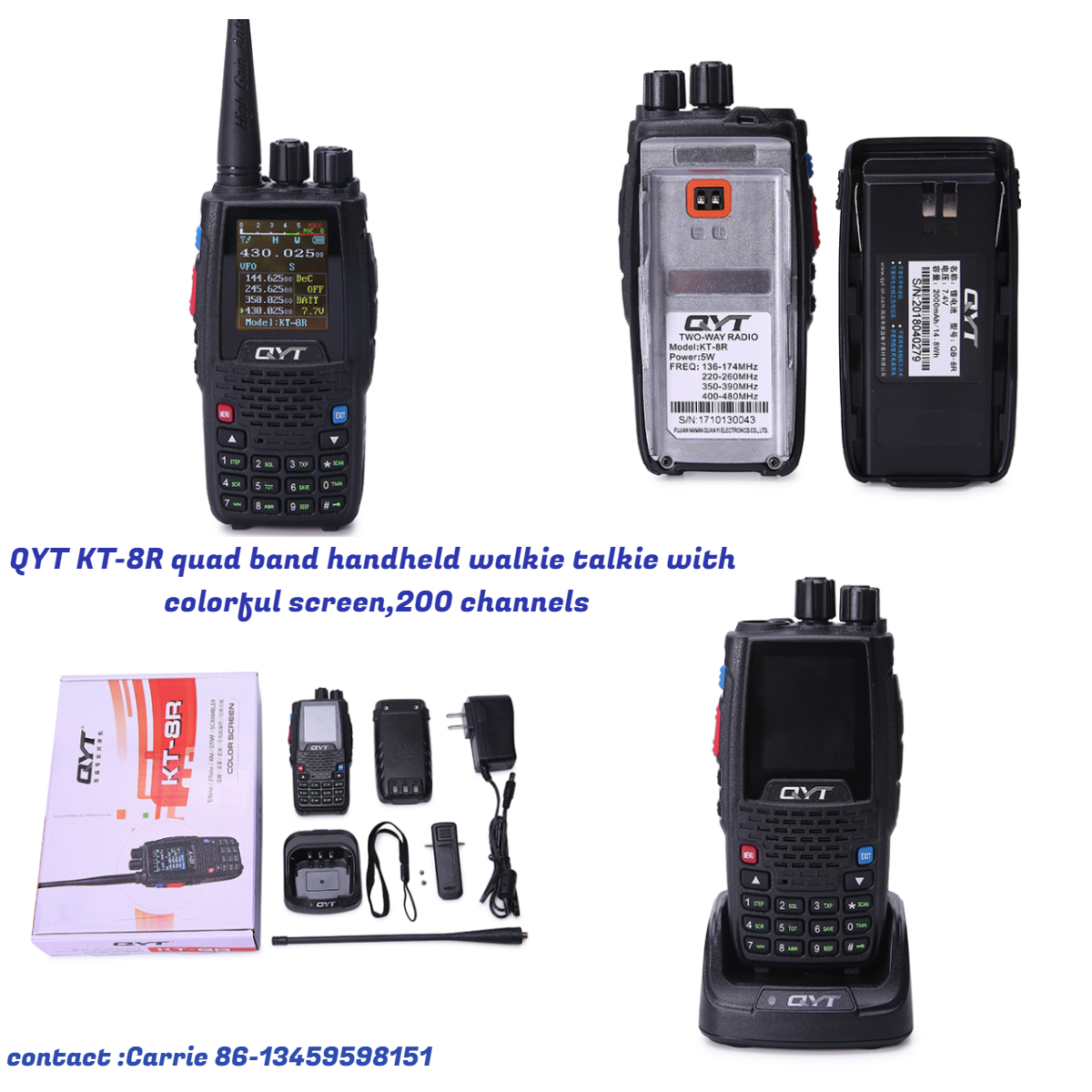
Product Showcase: The QYT KT-8R quad-band handheld transceiver pairs seamlessly with QYT mobile radios. Operators on foot maintain continuous, crystal-clear communication with vehicle-mounted stations across both VHF and UHF commercial spectrums.
What Power Output Do I Need for Long-Range Vehicle Fleet Communication?
Conclusion: For urban commercial operations under 20 km, 25 W is sufficient; for wide-area regional transit, coastal marine operations, or rugged rural terrain up to 50–80 km, enterprise buyers should specify 50 to 75 W mobile transceivers.
RF Power to Operational Range Matrix:
| Technical Dimension | Vehicle-Mounted Mobile Radio | Portable Handheld Walkie Talkie |
|---|---|---|
| RF Output Power Class | 25 W to 75 W (e.g., QYT KT-8900 / KT-980Plus) | 4 W to 10 W (e.g., QYT KT-8R) |
| Primary Deployment Role | Logistics fleets, marine vessels, dispatch desks | Warehouse staff, security patrols, on-foot workers |
| Typical Equipment Model | QYT KT-8900 / KT-WP12 / KT-980Plus | Standard Commercial Handheld / High-Power Handheld |
| Operating Voltage | 13.8V DC (Vehicle) | 7.4V DC (Battery) |
| Free-Space Line-of-Sight Range | 25 to 80 km | 5 to 12 km |
| Urban / Obstructed Terrain Range | 12 to 25 km | 1 to 5 km |
| Recommended Industry Scenarios | Cross-regional highway freight, marine fishing vessels, forestry, port yard tractors | Warehouses, retail, indoor construction |
| Operating Duty Cycle | Continuous duty cycle (heavy-duty aluminum heat sink) | Intermittent duty cycle (subject to battery depletion) |
| Power Supply System | Vehicle 12V/24V DC battery or 13.8V desktop supply | Built-in rechargeable Li-ion battery (7.4V) |
| Antenna Architecture | High-gain external roof whip antenna (+3 to +6 dBi) | Shortened flexible helical rubber duck antenna (0 dBi) |
| Audio Output Power | 2.0 W to 4.0 W (audible in noisy engine cabs) | 0.5 W to 1.0 W (optimized for quiet/earpiece use) |
| Ingress Protection | IP54 commercial / IP67 waterproof mic models | IP54 to IP67 submersible options |
| Weight & Form Factor | 1,000 g to 1,500 g (bracket-mounted fixture) | 150 g to 280 g (pocket/belt-clip portable) |
Physics & Propagation Note: Radio range does not scale linearly with RF wattage. Doubling operational range requires an approximately fourfold (6 dB) increase in transmitter effective radiated power (ERP), combined with elevated antenna placement. A 25 W mobile radio equipped with a roof-mounted 5/8-wave gain antenna frequently outperforms a 50 W unit operating on a poor, mismatched antenna.
How Do I Build a Mixed Mobile + Handheld Fleet Communication System?
Conclusion: An integrated commercial fleet architecture coordinates a central dispatch base station, vehicle-mounted mobile radios, and portable handheld walkie talkies across a structured multi-channel hierarchy.
3-Tier Integrated Fleet Architecture:
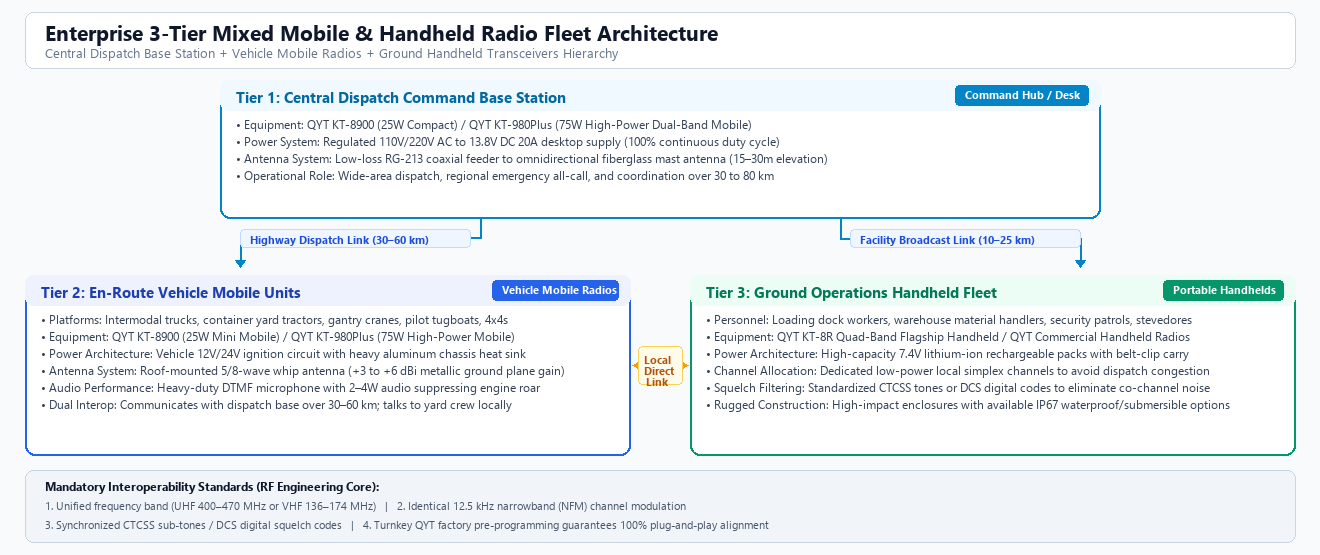
Architecture Diagram: The QYT 3-tier enterprise fleet framework integrates a central command base station (KT-8900/KT-980Plus on elevated mast antenna), vehicle mobile units (chassis-grounded roof antennas), and ground-crew handhelds (KT-8R portable transceivers) into a synchronized multi-channel hierarchy.
-
Tier 1: Central Dispatch Command (Fixed Base Station):
- Uses a high-power commercial mobile radio (such as the QYT KT-8900 or KT-980Plus) installed on a desktop dispatch console.
- Powered by a regulated 110V/220V AC to 13.8V DC 20A power supply.
- Connected to an omnidirectional fiberglass base antenna mounted on the facility roof (10 to 30 meters elevation) via low-loss RG-213 or LMR-400 coaxial cable. This base station covers the entire metropolitan operating territory.
-
Tier 2: Mobile Vehicle Fleet (En-Route Units):
- Fleet trucks, delivery vans, yard tractors, and supervisors' 4x4 vehicles are equipped with vehicle-mounted mobile radios powered by vehicle 12V/24V ignition circuits.
- Vehicle units communicate with the central dispatch station over 30 to 60 km, while relaying local instructions to ground personnel.
-
Tier 3: Ground Operations Crew (Portable Units):
- Loading dock workers, warehouse material handlers, and security officers carry lightweight, rugged handhelds (such as the QYT KT-8R).
- Handhelds communicate directly with forklift operators and yard trucks on dedicated low-power local channels, preventing channel congestion on the main dispatch channel.
Organizations looking to establish custom fleet architectures can consult QYT Custom OEM Engineering Services to tailor frequency programming, vehicle cabling kits, and base station power solutions.
④ Data Comparison: Mobile Radio vs. Handheld Walkie Talkie
Enterprise Mixed Fleet Procurement Checklist for B2B Buyers
Before issuing a commercial purchase order for a mixed mobile and handheld radio fleet, ensure your engineering team verifies these technical specifications:
- 1. Unified Frequency Band Allocation: Have you standardized all mobile and handheld transceivers on a single commercial band (e.g., UHF 400–470 MHz or VHF 136–174 MHz) to guarantee direct interoperability?
- 2. Regulatory Spectrum Licensing: Have you secured corporate frequency licenses (such as FCC Part 90 or CE RED commercial radio allocations) authorized for both 5W mobile portable and 25–50W high-power mobile base operations?
- 3. Vehicle Voltage Verification: Have you verified whether your fleet vehicles operate on standard 12V DC or commercial 24V DC electrical systems? (If 24V, specify 24V-tolerant mobile radios or 24V-to-13.8V DC-DC step-down converters).
- 4. Antenna Mounting Topology: Have you selected appropriate vehicle mounting hardware (magnetic mounts, trunk-lip brackets, or permanent NMO hole mounts) paired with proper coaxial cable lengths?
- 5. Channel Plan & CTCSS Segregation: Have you drafted a unified 16-channel matrix segregating long-range dispatch channels (high power) from short-range yard loading channels (low power)?
- 6. Turnkey Factory Pre-Programming: Have you submitted your frequency chart to QYT engineers to pre-flash all mobile radios and handhelds with matching channel names and squelch codes prior to shipping?
⑤ Real-World Commercial Case Studies
Case Study 1: Regional Freight Logistics Fleet Deployment (30 Mobiles + 60 Handhelds)
- Client Profile: A commercial intermodal logistics enterprise operating in Manchester, United Kingdom, managing container transport between inland freight terminals and regional distribution hubs.
- The Problem: The company previously equipped drivers with handheld walkie talkies. Handheld batteries frequently died halfway through 12-hour transport shifts, and drivers inside insulated truck cabs experienced complete signal loss when traveling more than 6 km from the dispatch depot. Yard workers and drivers were forced to use personal cellular phones, leading to delayed container drops and high monthly telecom bills.
-
The Solution: The enterprise deployed a synchronized mixed fleet from QYT:
- 30 × QYT KT-8900 25W Dual-Band Mobile Radios installed inside tractor cabs powered by 13.8V vehicle power, paired with roof-mounted 5/8-wave UHF antennas.
- 60 × QYT Commercial Handheld Radios issued to forklift drivers, yard checkers, and loading dock personnel.
- QYT factory engineers pre-programmed all 90 units with an identical 16-channel matrix, dedicating Channel 1 to Depot Dispatch and Channels 2–4 to local dock operations.
- The Operational Result: Vehicle-to-depot communication range expanded to 35 km without repeaters. Battery replacement downtime dropped to zero for truck drivers, and yard turnaround time per freight container decreased by 22%, saving the enterprise thousands of pounds in annual cellular dispatch charges.
Case Study 2: Deep-Water Container Terminal & Crane Network Integration
- Client Profile: A busy commercial port container terminal in Southeast Asia handling continuous maritime container vessel loading and quayside operations.
- The Problem: Quayside gantry crane operators working 45 meters above the ground in high-vibration, electrically noisy crane cabs could not clearly hear ground dockworkers using standard 0.5 W handhelds. Furthermore, handheld transceivers suffered severe signal shielding behind towering stacks of steel shipping containers.
-
The Solution: The terminal authority deployed an integrated QYT communications network:
- 16 × QYT KT-980Plus 75W High-Power Mobile Radios mounted inside gantry crane cabs and port pilot tugboats, utilizing 4 W external audio speakers to overcome ambient diesel engine noise.
- 80 × QYT Waterproof Handheld Radios deployed across ground stevedores and quayside mooring crews.
- All mobile and handheld transceivers were synchronized on licensed port UHF frequencies with discrete DCS digital squelch codes.
- The Operational Result: The high-power mobile stations on gantry cranes cut through container shadow attenuation, maintaining 100% communication reliability across the entire 3-kilometer quayside. Quayside loading efficiency improved by 18%, with zero missed safety commands recorded during tropical monsoon storms.
⑥ Frequently Asked Questions (FAQ)
What is the difference between a mobile radio and a walkie talkie?
A mobile radio is a vehicle-mounted or fixed-station transceiver delivering 25 to 75 W of RF power, powered by a 13.8V vehicle electrical system and an external roof antenna. A walkie talkie is a battery-powered portable handheld radio delivering 5 to 10 W for on-foot mobility.
How far can a 50 W mobile radio reach?
In open terrain, flat highway corridors, or coastal waters, a 50 W mobile radio equipped with an external roof antenna typically achieves 30 to 80 km of reliable communication range. In obstructed urban environments, coverage averages 10 to 25 km depending on terrain and building density.
Can a mobile radio and handheld walkie talkie talk to each other?
Yes, mobile radios and handheld walkie talkies communicate with 100% interoperability provided both are programmed with identical operating frequencies, matching channel bandwidth (12.5 kHz narrowband), and matching CTCSS or DCS sub-audible privacy codes.
Do I need a license for a vehicle-mounted radio?
Yes. Commercial mobile radios transmitting at 25 to 75 W operate on licensed business frequency spectrums (such as FCC Part 90 in the United States or CE RED commercial UHF/VHF allocations in Europe). Operators must hold valid corporate frequency authorizations before transmitting.
What is the best mobile radio for fleet vehicle communication?
The best mobile radio provides rugged cast-aluminum heat sinking, at least 25 W RF output, multi-band frequency flexibility, and compatibility with vehicle power. The QYT KT-8900 (25 W compact) and QYT KT-980Plus (75 W high power) are industry-leading choices for fleet transport.
Can a mobile radio be used as a desktop base station?
Yes. By connecting a mobile radio (such as the QYT KT-8900) to a regulated 110V/220V AC-to-13.8V DC power supply and an external rooftop antenna, the mobile transceiver functions as a powerful, cost-effective central dispatch base station.
Upgrade Your Commercial Fleet with QYT Engineering Excellence
Coordinating commercial vehicle fleets and ground crews requires robust, field-tested wireless hardware. Whether outfitting logistics trucks with 25W/75W mobile transceivers, equipping quayside cranes with heavy-duty base stations, or supplying dock crews with rugged handhelds, QYT Electronics provides end-to-end manufacturing and engineering support:
- Factory-Direct Supply: Direct manufacturer pricing with zero middleman wholesale markup.
- Pre-Synchronized Mixed Fleets: Submit your corporate channel charts; QYT burns matching frequencies, CTCSS tones, and alphanumeric labels into both mobile and handheld units prior to shipment.
- OEM Customization & Branding: Private-label silk-screening, custom metal serial badges, bespoke chassis colors, and packaging.
- Global Export Certification: Full regulatory export documentation provided including CE, FCC, RoHS, and MSDS safety transit certificates.
- Comprehensive Warranty: 1-year transceiver body warranty, 6-month accessory warranty, and lifetime English remote engineering technical support.
Ready to deploy a synchronized mobile and handheld communication fleet for your enterprise? Contact the QYT Technical Sales and Engineering Team to discuss custom frequency specifications, sample evaluation units, and volume fleet pricing.