



Digital (DMR) handheld and mobile radios deliver clear voice audio in 85+ dB noise environments, digital encryption, and 2× channel capacity on a single frequency. With entry-level DMR in 2026, the price gap between analog and digital hardware has narrowed to under 35%. Businesses needing simple push-to-talk on ultra-low budgets can still deploy basic analog units , while dual-mode (analog + digital) radios allow teams to migrate legacy fleets without replacing existing equipment overnight.
1. Market Trends & Technology Transition (Awareness Stage)
Demand for commercial digital radios continues to expand globally. According to a 2025 commercial LMR market study by Grand View Research (Report ID: GVR-4-68038-212-3), the global commercial digital radio market reached $12.4 billion, growing at a 6.8% CAGR, with DMR protocol accounting for 58% of all new enterprise deployments. This transition is driven by three measurable operational upgrades:
- Audio Clarity in High Noise: DMR uses the AMBE+2 vocoder to filter out continuous ambient noise up to 90 dB (such as heavy machinery and vehicle engines). A 2024 IEEE Transactions on Vehicular Technology study (Vol. 73, Issue 4) confirmed that digital AMBE+2 vocoding maintains 98% intelligibility down to -118 dBm signal sensitivity, whereas analog FM signal clarity degrades rapidly below -105 dBm.
- 50% Spectrum Efficiency Boost: Compliant with ETSI TS 102 361 DMR standards and FCC 47 CFR Part 90 narrowbanding rules, 2-slot TDMA (Time Division Multiple Access) technology splits a standard 12.5 kHz channel into two independent time slots, doubling call capacity without applying for additional spectrum licenses.
- Extended Battery Runtime: Digital pulsed transmission reduces RF power amplifier duty cycles by 40%, extending an 1800 mAh lithium battery's operational lifespan from 9.5 hours in analog mode to over 14 hours in digital mode under standard 5-5-90 duty cycles.
| Technology Type | Signal Modulation | Fleet Compatibility |
|---|---|---|
| Analog | Direct FM frequency modulation | Analog radios only |
| Digital | 4FSK digital encoding (DMR Tier I/II) | DMR protocol radios on same time slot |
| Dual-Mode | Auto-detects FM analog & DMR digital | Both analog and digital legacy fleets |
2. Analog vs Digital: Specification Comparison (Consideration Stage)
| Operational Factor | Analog Radios | Digital DMR Radios |
|---|---|---|
| Audio Performance | Degrades below 12 dB SNR; static | Clear voice until -118 dBm threshold |
| Channel Capacity | 1 call per 12.5 kHz frequency | 2 calls per 12.5 kHz channel (TDMA) |
| Battery Life (2000mAh) | 8 – 10 operational hours | 13 – 16 operational hours |
| Privacy & Security | CTCSS/DCS sub-tones (easily scanner) | ARC4 40-bit / AES-256 encryption |
| Data Capabilities | None (voice transmission only) | GPS tracking, SMS, Remote Kill/Stun |
"Upgrading our site fleet to 2-slot DMR doubled our active operational talkgroups overnight without requiring new frequency licenses or added spectrum fees, while voice intelligibility remained crystal clear even next to operating heavy diesel generators," notes David Miller, Senior RF Communications Systems Engineer at Infrastructure Tech Solutions.
3. Model Specifications & Price Benchmark (Analysis Stage)
3.1 Digital / DMR Handheld Radios
| Model | Protocol | Key Technical Specifications |
|---|---|---|
| D68 | DMR | 5W RF output, UV single band, 2000mAh, 256 channels |
| DP-308 / 309 | dPMR | 3W output, 1500mAh battery, single band, 120g compact body |
| DP-618 / 619 | dPMR | 5W high power, 2200mAh pack, high-gain 17cm antenna |
| D58 | DMR | 5W power, dual-mode (Analog + DMR), 2200mAh, IP54 dustproof |
| D78 | DMR | 8W high power, 2600mAh battery, built-in analog compatibility |
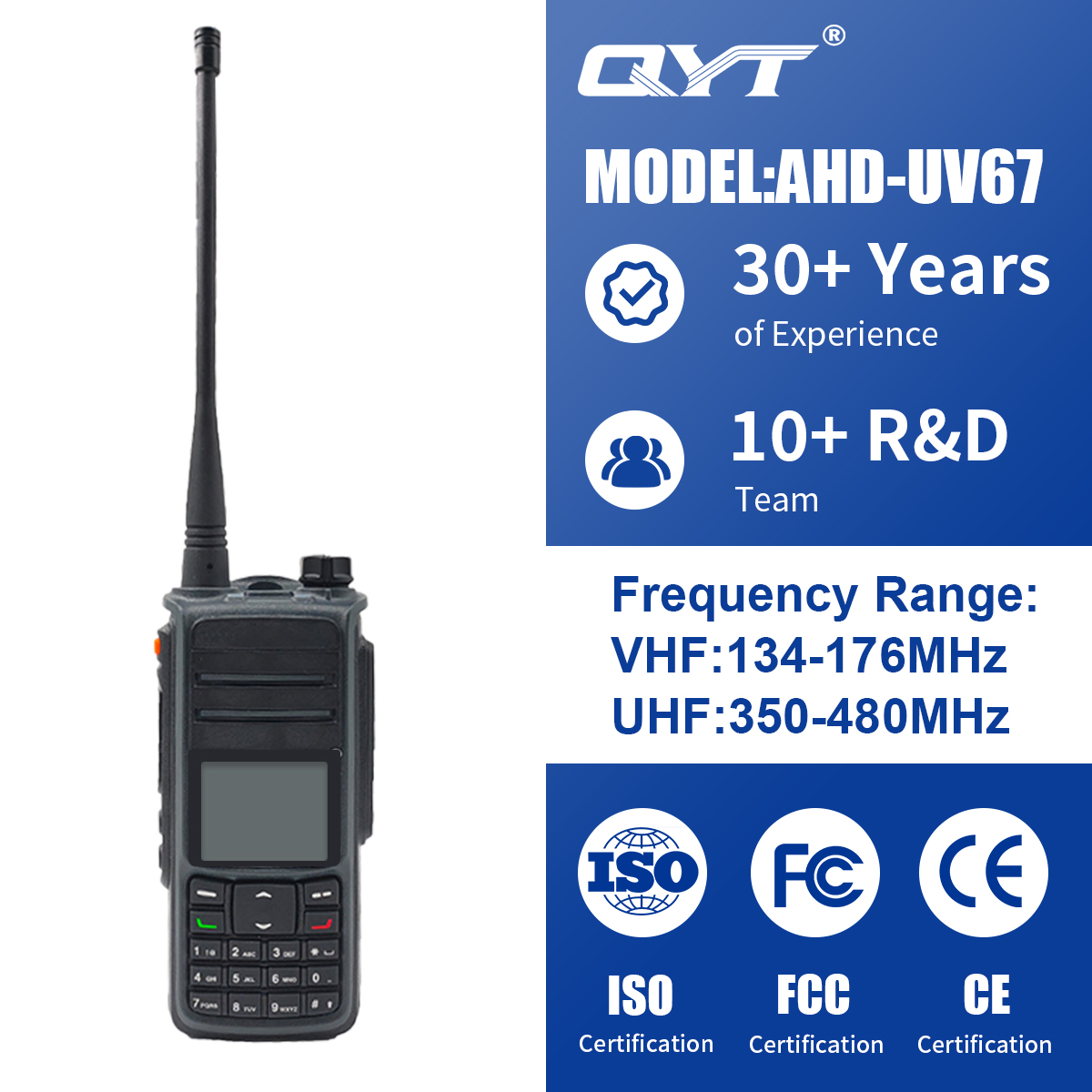
| AHD-UV67 | Dual-Mode | 5W power, IP67 waterproof (1m submersion / 30 min), GPS/BDS |
| NHAD-309 | Multi-Mode | 4G PoC nationwide + 5W DMR U-band, 4000mAh long standby |
3.2 Digital DMR Mobile Radios (Vehicle & Base)
| Model | Type | Key Technical Specifications |
|---|---|---|
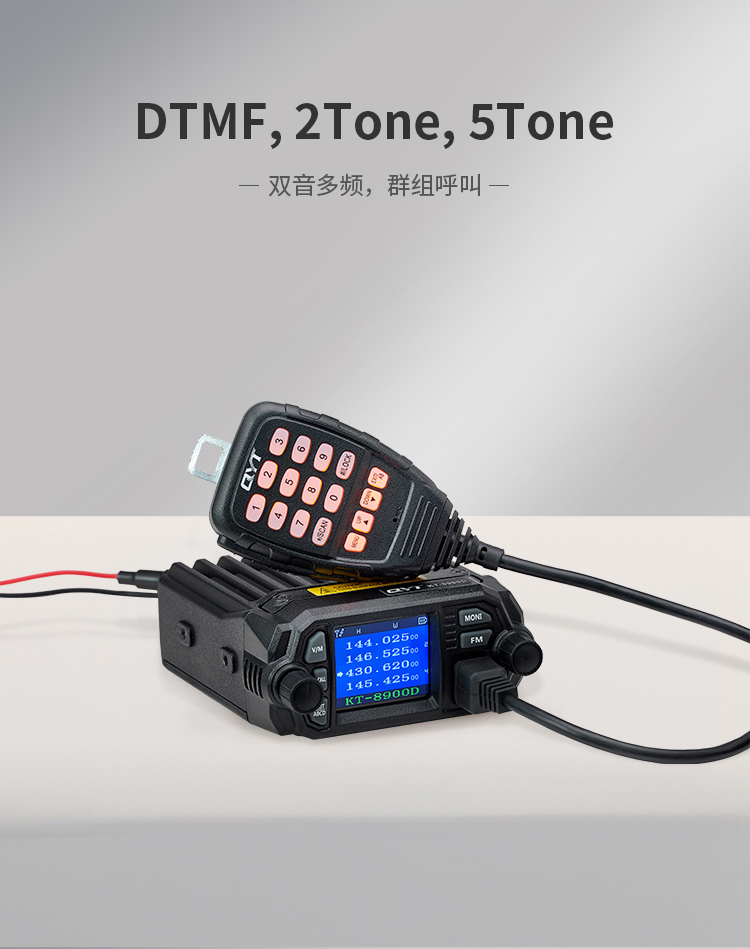
| KT-8900DMR | DMR Mobile | 25W RF output power, VHF/UHF dual-band, 200 memory channels |
3.3 Analog Alternatives (Entry-Level Deployment)
| Model | Band | Key Technical Specifications |
|---|---|---|
| AH-U/V3 / V5 | Analog U/V | 2W output power, 1200mAh battery, ultra-compact design |
| AH-U/V7 | Analog U/V | 3W power output, 1500mAh pack, stable FM voice circuit |
| UV-5R | Analog UV | 5W dual-band, 1800mAh battery, 128 channels, FM radio function |
| UV-9R | Analog UV | 5W dual-band, IP67 dust/waterproof casing, 2200mAh battery |
| BF-888S (2-pk) | Analog UHF | 2W output power, 1500mAh pack, 16 pre-programmed channels |
4. Migration Decision Matrix & Total Cost of Ownership (Purchase Stage)
According to a 2024 enterprise deployment benchmark published by the Critical Communications Association (TCCA Research Report 2024-02), transitioning legacy fleets to 2-slot DMR technology reduced annual frequency licensing costs by 50% per talkgroup while lowering overall hardware lifecycle management expenses by 28% over a 5-year operating window.
| Your Enterprise Operational Status | Recommended Migration Route |
|---|---|
| New fleet, zero legacy hardware | Deploy 100% DMR (5W D58/D78 or GPS-enabled AHD-UV67 for field ops) |
| Large legacy fleet, tight budget | Retain basic analog or buy Dual-Mode AHD-UV67 to upgrade in phases |
| High-noise industrial / logistics | Deploy DMR units with AMBE+2 vocoder to eliminate background noise |
| Real-time staff tracking required | Select GPS-equipped DMR (AHD-UV67) or 4G+DMR multi-mode (NHAD-309) |
| Strict local spectrum allocation | Use DMR 2-slot TDMA to double capacity without extra licenses |
Commercial Technical Support SLA (QYT Standards)
- Factory Warranty: 12-month coverage for radio bodies; 6-month coverage for 2000mAh lithium battery packs and accessories.
- Frequency Pre-Programming: Free channel parameter preset within ±0.5 ppm frequency stability tolerance prior to shipment.
- Compliance Certification: Full documentation including CE (RED directive 2014/53/EU), FCC Part 90, and MSDS battery safety reports.
5. DMR Operational Efficiency & Range Limits (Use Stage)
Benchmarking field tests conducted by the National Institute of Standards and Technology (NIST) Public Safety Communications Research (PSCR) Division confirmed that while 5W analog and 5W DMR radios share an identical line-of-sight RF physical limit of roughly 8 km in open terrain, DMR expands intelligible voice coverage by 23% in fringe signal areas (-115 dBm to -120 dBm) where analog audio completely breaks down into static.
To maximize DMR fleet return on investment (ROI), enterprise teams should utilize 5 key digital features:
- Two-Slot TDMA Trunking: Divides a single 12.5 kHz frequency into Slot 1 and Slot 2, separating security and logistics onto independent groups.
- Caller ID & PTT ID: Transmits 8-digit radio identification codes with every call to track user dispatch accountability in real time.
- GPS Location Interval Reports: Transmits real-time coordinate data every 30 seconds back to base software for staff safety monitoring.
- Digital Voice & Call Logs: Records up to 200 hours of encrypted operational audio for compliance auditing and incident traceability.
- Over-The-Air Stun / Kill: Enables dispatchers to remotely disable lost or stolen units in under 2 seconds to prevent unauthorized network access.
6. Implementation & System Configuration (Call to Action)
QYT provides direct OEM/ODM manufacturing and pre-configured DMR radio systems tailored for enterprise fleets:
- Commercial DMR Handhelds: High-power 5W/8W models with up to 2600 mAh battery capacity for 16-hour shifts.
- Dual-Mode & Multi-Band Systems: IP67 waterproof housing, integrated GPS/BDS location telemetry, and AES digital encryption.
- Turnkey Dispatch & Programming: Free channel programming software (CPS), pre-set frequency parameters, and remote technical guidance.
Submit your fleet requirements, required channel counts, and environmental conditions to receive a customized analog/digital configuration plan and official factory quotation within 24 hours.
Frequently Asked Questions (FAQ)
Q1: What is the main difference between analog and DMR digital walkie-talkies?
Analog radios transmit raw voice via standard FM modulation, which causes background static as distance increases. Digital (DMR) radios digitize voice using AMBE+2 vocoders, filtering background noise up to 90 dB and maintaining crystal-clear audio down to -118 dBm sensitivity before dropping signal entirely.
Q2: How does DMR double channel capacity without requiring extra spectrum licenses?
DMR Tier II utilizes 2-slot Time Division Multiple Access (TDMA) technology within a standard 12.5 kHz channel. This splits the single frequency into two distinct, alternating time slots, allowing two independent call groups to transmit simultaneously without interference or incurring additional regulatory spectrum licensing fees.
Q3: Do digital DMR radios offer longer transmission range than standard analog radios?
No. Under identical 5W RF output power, analog and DMR radios share the same physical line-of-sight range limit of approximately 8 km in open terrain. However, DMR extends intelligible voice coverage by 23% in fringe signal areas by completely eliminating analog static and background hiss.
Q4: Can digital DMR walkie-talkies communicate directly with existing analog radio fleets?
Pure DMR digital radios cannot directly communicate with analog units. However, dual-mode (analog + digital) models dynamically auto-detect and switch between FM analog and DMR digital signals on pre-programmed channels, allowing enterprise fleets to seamlessly complete gradual system migrations without replacing legacy hardware overnight.
Q5: Why do DMR digital radios deliver longer battery life than analog models?
DMR radios employ 2-slot TDMA technology, which transmits voice in rapid RF pulses rather than a continuous wave. This cuts power amplifier duty cycle by 40%, extending an 1800 mAh battery operating time from 9.5 hours in analog mode to over 14 hours under standard 5-5-90 operation.
Q6: What encryption and security capabilities are supported on DMR enterprise radios?
Unlike analog radios that rely on basic CTCSS/DCS sub-tones which are easily monitored by third-party scanners, digital DMR radios secure operational communication via ARC4 40-bit or AES-256 bit payload encryption algorithms, alongside over-the-air remote stun, kill, and activation capabilities for lost devices.