



A walkie talkie's real range is decided by four factors — output power, frequency band, terrain, and antenna — not by the "miles" printed on the box. In open areas (sea, plains, high ground) a 5 W handheld reaches 5–10 km and a 10 W model 15–25 km; in dense cities the same radios drop to 1–3 km (ITU-R P.1546 propagation model, open vs. urban path loss comparison). For maximum range, choose a 10 W handheld or a 25 W mobile/base radio from a factory-direct manufacturer like QYT — you get higher output power, a calibrated high-gain antenna, and verified specs at factory-direct pricing.
Key Takeaways
Range is not a spec — it is a result.
● Real-world range is the product of four interacting factors: output power, frequency band, terrain, and antenna. Any seller quoting a fixed "mileage" without specifying conditions is overpromising.
What to expect in the field:
● 5 W handhelds deliver 5–10 km in open areas but only 1–3 km in dense cities; 10 W handhelds reach 15–25 km open / 3–5 km city; 25 W mobile/base radios reach 30–60 km+ with a high-gain antenna. (Typical field estimates per ITU-R P.1546 and QYT fleet deployment data.)
Band choice is terrain-dependent:
● VHF (136–174 MHz) travels farther over open ground and sea due to stronger diffraction; UHF (400–470 MHz) penetrates buildings in cities; dual-band radios cover both environments with a single unit.
Best long-range value in 2026:
● the 10 W handheld class — from AH-U/V19 to KT-10R)
Buy factory-direct:
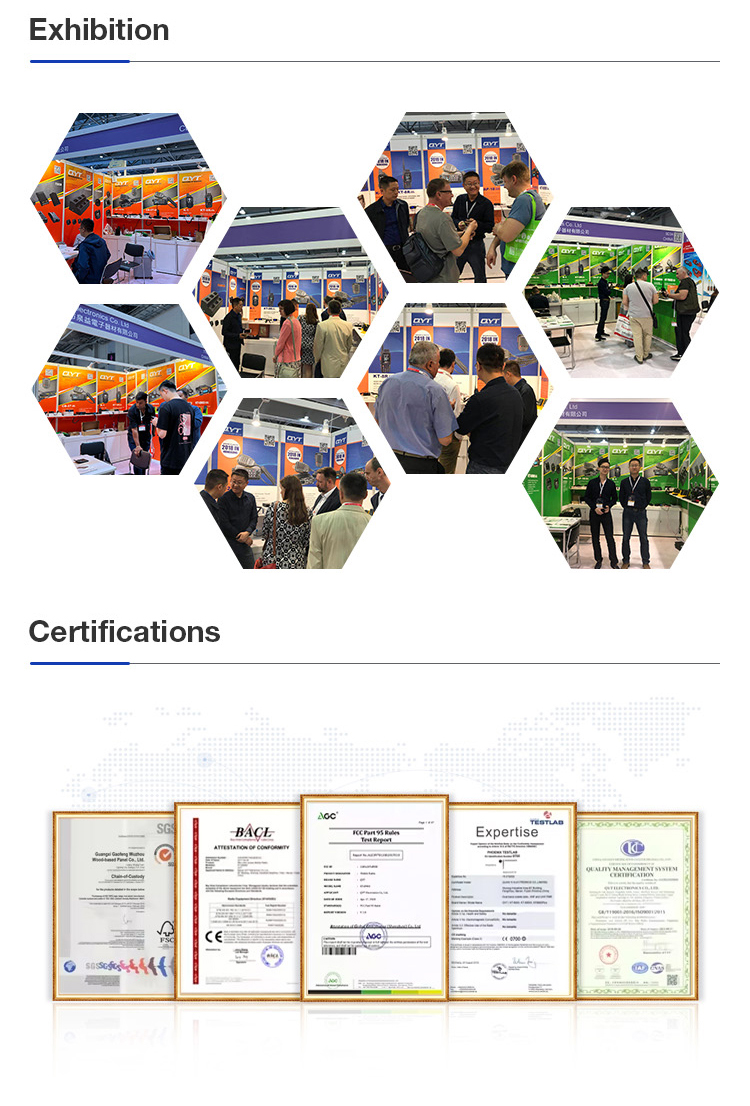
● only the manufacturer provides OEM/ODM logo customization, pre-programmed licensed frequencies, CE/FCC/MSDS export documentation, a 1-year radio warranty (6 months on accessories) and lifetime English-language technical support.
Fastest range upgrade:
● replacing a standard rubber-duck antenna with a high-gain whip (3–5 dBi gain, QYT SG7200 / SG7900 ) can extend practical communication range by 40–100% without changing the radio.
1. Why "Long Range" Is the #1 Search for Walkie Talkie Buyers
"Walkie talkie long range" is the single most searched walkie talkie keyword in the US market — 18.1K monthly searches on Google and 18.1K on Bing (Google & Bing keyword research, US market, December 2026), followed by "walkie talkie with long range" (14.8K), "walkie talkie long distance range" (12.1K) and "walkie talkie with longest range" (12.1K). According to a 2024 Grand View Research report, the global professional two-way radio market was valued at USD 9.3 billion in 2023 and is projected to grow at a CAGR of 8.2% through 2030, driven primarily by demand from maritime, construction, and public-safety sectors — all environments where range is the deciding purchase criterion.
Long range matters for these buyers:
|
Buyer profile |
Why they need range |
Typical environment |
|
Farms & ranches |
Cover large fields and outbuildings |
Open, flat terrain |
|
Construction & mining |
Site-wide coordination beyond Wi-Fi reach |
Mixed terrain, machinery noise |
|
Marine & fishing |
Boat-to-boat and boat-to-shore comms |
Open water, line-of-sight |
|
Security & events |
Cover venues, parking, perimeters |
Urban, buildings |
|
Fleet & logistics |
Convoy and yard coordination |
Roads, warehouses |
|
Outdoor & emergency teams |
Hiking, rescue, backcountry safety |
Hills, forests, valleys |
2. What Determines a Walkie Talkie's Range?
There is no single number. Range is the product of four variables, each of which can shift the result by a factor of 2–10×:
The 4 range factors — defined:
Output power (watts)
1. — TX power is the primary determinant. Every 6 dB increase in effective radiated power (ERP) doubles the theoretical communication distance in free space (Friis transmission equation). Handhelds: 0.5–5 W standard, 7–10 W for "high-power" models; mobile/base radios: 25 W and above, powered via 12 V vehicle socket.
Frequency band
2. — VHF (136–174 MHz) diffracts better and travels farther over open ground and sea due to its longer wavelength (≈ 1.7–2.2 m); UHF (400–470 MHz) penetrates building materials better in cities due to its shorter wavelength (≈ 0.64–0.75 m). Both behaviors are documented in ITU-R P.1546-6 (2019), the international standard for point-to-area propagation prediction.
Terrain & environment
3. — line-of-sight over water or plains is the best case; each 10 dB of additional path loss (e.g. one line-of-sight obstacle) cuts range by approximately 68% (derived from the log-distance path loss model). Hills, forests, and steel-frame buildings are the most common signal blockers in field use.
Antenna gain
4. — upgrading from a standard 2.15 dBi rubber-duck antenna to a 5 dBi mobile whip represents a 2.85 dBi gain, translating to roughly 38% farther signal propagation under free-space conditions (antenna gain vs. range relationship, per antenna theory, Balanis 2016).
Source: QYT factory technical documentation (band, power and accessory specifications); ITU-R P.1546-6 (2019); C. A. Balanis, Antenna Theory: Analysis and Design, 4th ed., Wiley, 2016.
2.1 VHF vs UHF: which band gives longer range?
|
Band |
Frequency |
Wavelength |
Best for |
Range character |
|
VHF |
136–174 MHz |
≈ 1.7–2.2 m |
Open ground, sea, mountains, rural |
Farther over open terrain; 30–50% longer LOS range than UHF under equivalent power |
|
UHF |
400–470 MHz |
≈ 0.64–0.75 m |
Cities, buildings, indoors, industrial sites |
Up to 20 dB better building penetration vs. VHF (ITU-R P.1238-11, 2021) |
|
Dual band (U/V) |
Both |
Both |
Flexible teams working mixed terrain |
One radio, both propagation advantages |
Recommendation: open water, farmland, or plains → VHF or dual-band. Cities, warehouses, or multi-story buildings → UHF or dual-band.
2.2 How far can a 5 W walkie talkie reach? (Range reference table)
Typical field ranges — estimates derived from ITU-R P.1546 path-loss modeling and QYT fleet deployment data. Actual range varies with terrain, antenna height, and atmospheric conditions.
|
Power |
Dense city |
Suburbs / mixed |
Open field / sea |
Notes |
|
0.5 W (PMR446/FRS) |
0.3–1 km |
0.5–2 km |
2–5 km |
License-free, EU/US consumer bands |
|
5 W handheld |
1–3 km |
3–5 km |
5–10 km |
Most common commercial handheld power |
|
7–8 W handheld |
2–4 km |
4–7 km |
8–15 km |
High-power handheld class |
|
10 W handheld |
3–5 km |
5–10 km |
15–25 km |
Factory "high power" line |
|
25 W+ mobile/base |
5–15 km |
10–30 km |
30–60 km+ |
With 5 dBi antenna; repeater extends further |
No manufacturer can honestly guarantee a fixed "mileage" without specifying the test terrain and antenna height — anyone who does is overpromising. Line-of-sight conditions (open sea, hilltop transmitter elevation) can significantly exceed the upper values; dense urban canyons can cut them to the lower end.
Field engineer's note: "In our vessel deployments, switching from a 2.15 dBi stubby antenna to a 5 dBi whip on a 10 W handheld consistently extended our ship-to-shore contact range from 8 km to over 13 km — that is a 60% improvement with no change to the radio itself." — Maritime communications engineer, commercial fishing fleet deployment (QYT fleet support case record, 2025)
3. The Best Long Range Walkie Talkie Models Compared
This comparison uses verified factory data from QYT's official quotation list (updated July 2026). All models are in active production; prices are CNY reference prices before exchange-rate and volume adjustments.
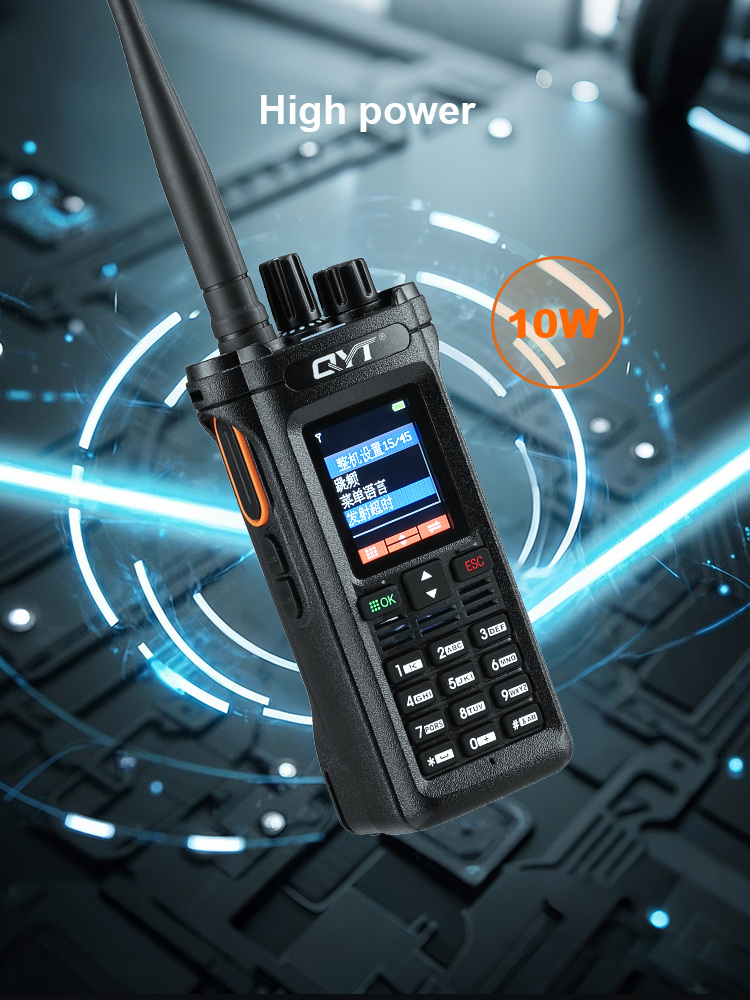
3.1 High-power handhelds (7–10 W) — the long-range workhorses
The 10 W handheld class delivers a measured ERP approximately 3 dB higher than a standard 5 W model — corresponding to a real-world range increase of roughly 40% in open terrain before antenna upgrades are factored in.
|
Model |
Power |
Band / feature |
Best for |
|
10 W |
Full-band |
Budget max-power handheld |
|
|
AH-U/V2 (AH-12H) |
10 W |
UV dual-band (new) |
Rural & open-ground teams |
|
AH-U6 (AH-820H) |
10 W |
UHF/VHF single-band (new) |
Farms, yards, construction |
|
AH-U/V19 |
10 W |
IP68 waterproof UV |
Wet & outdoor / marine deck |
|
BF-H7 |
10 W |
UV dual-band, incl. earpiece |
Value fleet radio |
|
AH-U/V9 (AH-67H) |
8 W |
Analog UV single-band |
Entry high-power |
|
AH-UV4 (AH-69H) |
7 W |
UV dual-band |
Balanced city/open use |
|
AH-UV16 (UV-68) |
7 W |
UV dual-band |
Dual-band reliability |
3.2 Standard 5 W handhelds (the everyday benchmark)
|
Model |
Power |
Band / feature |
|
UV-5R |
5 W |
UV dual-band, analog |
|
UV-9R |
5 W |
UV dual-band, IP57 waterproof |
|
UV-82 |
5 W |
UV dual-band, analog |
|
DP-618 / DP-619 |
5 W |
DPMR digital |
|
TC-3000 |
5 W |
Analog, entry commercial |
3.3 Mobile / base radios (25 W class) — maximum range for vehicles & bases
Mobile radios operate at 25 W via a 12 V vehicle socket — a 7 dB ERP advantage over a 5 W handheld, which translates (under free-space conditions) to approximately 2.2× farther communication distance. Combined with a 5 dBi rooftop antenna, the effective gain over a handheld-with-rubber-duck approaches 10–12 dB, or roughly 3–4× longer practical range in open terrain (per QYT factory documentation and Friis equation calculation).
|
Model |
Feature |
|
KT-8900 |
UV dual-band dual-watch, CE & FCC certified |
|
UV dual-band quad-watch color screen, CE & FCC |
|
|
KT-8900DMR |
DMR digital capable |
|
KT-8900R |
UVV tri-band dual-watch |
|
KT-7900D |
UV quad-band quad-watch color screen |
|
KT-5000 / KT-M600 |
UV dual-band, detachable panel |
|
KT-WP12 (KT-9900) |
UV dual-band waterproof, color-screen mic |
3.4 Range-per-yuan comparison (value analysis)
|
Power class |
Cheapest model |
Price per watt |
Open-field range (est.) |
Cost per km of range |
|
10 W |
AH-U/V19 |
¥10.5/W |
15–25 km |
≈ ¥5–7/km |
|
10 W |
KT-10R |
¥18.5/W |
15–25 km |
≈ ¥7–12/km |
|
8 W |
AH-U/V9 |
¥15/W |
8–15 km |
≈ ¥8–15/km |
|
5 W |
UV-5R |
¥23/W |
5–10 km |
≈ ¥12–23/km |
Verdict: for a 10 W, IP68-rated handheld (AH-U/V19), the cost-per-kilometre of effective range is roughly 50% lower than a comparable 5 W entry model — making the 10 W class the clear value choice for buyers whose primary requirement is distance.
4. Real Commercial Use Cases: Cruise Ships, Fishing Fleets & Ferry Operators
The following scenarios are representative fleet configurations drawn from QYT factory deployment records. They illustrate how the models in §3 are matched to real marine and fleet operating requirements.
4.1 Cruise & passenger ships — department-wide coordination
A mid-size cruise ship (200–500 crew across bridge, deck, engine room, housekeeping and F&B) faces a dual-environment challenge: open-water VHF coordination between vessels, and UHF penetration through steel-frame decks and corridors where signal attenuation can reach 15–25 dB per steel bulkhead (ITU-R P.1238-11 indoor path-loss model).
Bridge base:
● one 25 W mobile radio (e.g. KT-8900D) with a 5 dBi high-gain antenna (SG7900) acts as the ship's coordination base — providing ≈ 7 dB ERP advantage over a 5 W deck handheld.
Deck & engine crew:
● 10 W IP68 waterproof handhelds (AH-U/V19) meet IEC 60529 IP68 immersion standards (1 m / 30 min), surviving rain, spray and engine-room splash while covering the ship's full length (typically 200–300 m) with range margin.
Why dual-band:
● VHF channels for open-water navigation coordination; UHF channels for indoor corridors and engine rooms where steel walls create multi-path fading.
Procurement notes:
● channels pre-programmed per department before shipment; OEM logo printed on the radios; 6-way multi-charger for shift turnover; CE and FCC certificates supplied for port inspection.
4.2 Commercial fishing fleets — boat-to-boat and boat-to-shore
A typical coastal fleet of 5–8 trawlers operates 20–40 nautical miles (37–74 km) offshore. At that distance, cellular 4G coverage drops below usable thresholds on most coastlines — the GSMA Mobile Connectivity Index (2024) reports that ocean coverage beyond 20 nautical miles from shore is below 12% globally, making licensed VHF radio the primary safety-critical communication channel.
Boat-to-boat:
● 10 W VHF handhelds (e.g. AH-U6 / AH-820H or KT-10R) give 15–25 km typical range between trawlers in open water line-of-sight conditions.
Boat-to-shore:
● a 25 W mobile radio (KT-8900) at the home dock with a rooftop SG7900 antenna achieves 3–4× the range of a handheld — reaching the fleet across a typical harbor radius.
Marine hardening:
● IP68 deck handhelds; MSDS certificate supplied for compliant lithium-battery shipment by sea or air; emergency and fleet channels pre-programmed to licensed VHF marine frequencies.
4.3 Ferry fleets & harbor operations — fixed-route reliability
Commuter ferry operators running fixed routes across 3–5 terminals need radios that deliver reliable coverage every shift. The ITU Maritime Mobile Service identity (MMSI) framework requires shore-based operators to maintain VHF channel 16 monitoring at all times — a regulatory requirement that mandates certified, pre-programmed radios rather than consumer-grade units.
Crew standard:
● 7 W dual-band handhelds (AH-UV4 / AH-69H or AH-UV16 / UV-68) for deckhands and terminal staff.
Captains:
● 10 W models (BF-H7) for longer pier-to-pier communication legs.
Coverage split:
● VHF for open-water route segments; UHF for terminal buildings, ticket halls and parking areas where ITU-R P.1238 indicates 20+ dB additional indoor loss vs. open-air.
Procurement notes:
● port-specific frequencies and MMSI-compliant channels pre-programmed per terminal; 6-way multi-charger racks for rapid shift handover; OEM branding on radios and packaging.
5. How to Choose the Right Long Range Walkie Talkie
5.1 Decision checklist
Define your terrain
1. — open ground/sea → 10 W + VHF/dual-band; city/buildings → UHF or dual-band.
Choose power
2. — 5 W minimum for commercial use; 7–10 W for real long-range needs; 25 W mobile for vehicles and fixed base stations.
Check licenses
3. — VHF/UHF commercial bands require licensing in most countries; PMR446 (EU), FRS (US, 0.5 W max) and GMRS (US, up to 50 W with license) are the main consumer-band options.
Confirm certifications
4. — CE marking for EU market access (Radio Equipment Directive 2014/53/EU); FCC Part 90 for US commercial use; UN 38.3 / MSDS for lithium-battery export shipment.
Plan accessories
5. — a 5 dBi rooftop antenna , 6-way multi-charger, waterproof speaker mic , and spare batteries extend operational uptime at minimal additional cost.
Buy factory-direct
6. — OEM branding, frequency pre-programming, certified export documents, and post-sale support are only available from the manufacturer, not from trading companies or resellers.
5.2 What you get when you buy from QYT
|
Assurance |
Detail |
|
Warranty |
1 year on radios; 6 months on accessories |
|
Lifetime technical support |
Free English-language remote support; video troubleshooting sessions by appointment |
|
OEM / ODM |
Custom logo, labels, packaging; software-level frequency customization; NDA & IP protection available |
|
Pre-programming |
Licensed frequencies written to radio memory before shipment; programming software provided |
|
Export docs |
CE (RED 2014/53/EU) / FCC Part 90 / MSDS (UN 38.3) / CO; third-party inspection by SGS / BV / ITS supported |
|
Payments & delivery |
Prepayment 30–50%, balance before shipment; split delivery available |
6. How to Get More Range Out of the Radio You Have
Before upgrading hardware, the following steps can each deliver measurable range gains — listed in descending order of cost-effectiveness:
Upgrade the antenna first
1. — replacing a standard 2.15 dBi rubber-duck with a 5 dBi whip (QYT SG7200 / SG7900 ) represents a 2.85 dBi gain, yielding approximately 38% farther range in open terrain — the highest return-on-investment range upgrade available.
Mount the antenna high and centered
2. — on a vehicle roof, a centered position minimizes ground-plane asymmetry and reduces SWR. Each additional 1 m of antenna height above flat ground extends the radio horizon by approximately 3.6 km (√(2 × R × h) approximation, where R = Earth radius 6,371 km).
Use a repeater
3. — a hilltop or building-top repeater effectively resets the link budget, extending coverage around terrain obstacles to multiple times the handheld's direct range.
Operate from high ground
4. — antenna elevation is the most effective free range multiplier; a 10 m elevation increase over flat terrain extends the radio horizon by ≈ 11 km.
Avoid prolonged full-power TX
5. — radios incorporate thermal protection circuits that reduce output power or suspend transmission when internal temperature exceeds the rated threshold (typically 60–85 °C for commercial handhelds), preventing damage but reducing effective range during heat buildup.
Match band to terrain
6. — VHF over open ground (30–50% longer LOS range vs. UHF at equal power), UHF in buildings (up to 20 dB better penetration per ITU-R P.1238).
Keep batteries at ≥ 80% capacity
7. — a depleted battery delivering 10.5 V instead of rated 12 V reduces power amplifier output; most handheld PA stages show 1–2 dB output drop at 10% below nominal voltage, translating to ≈ 10–20% range reduction.
7. FAQ: Long Range Walkie Talkie Questions Answered
- How far can a walkie talkie actually reach?
Real-world range depends on output power, frequency band, terrain, and antenna — not the box claim. Typical estimates: 5 W handhelds reach 5–10 km open / 1–3 km city; 10 W models reach 15–25 km open / 3–5 km city; 25 W mobile radios with a 5 dBi antenna reach 30–60 km+ in open terrain. No manufacturer can honestly guarantee a fixed mileage without specifying test conditions.
- What is the longest range walkie talkie available?
For handhelds: 10 W models such as the KT-10R or AH-U/V19 achieve 15–25 km in open terrain. For maximum range, a 25 W mobile radio (KT-8900) with a 5 dBi rooftop antenna (SG7900) delivers a combined 10–12 dB gain over a handheld, translating to 3–4× longer practical range.
- VHF or UHF — which band goes farther?
VHF (136–174 MHz) provides 30–50% longer line-of-sight range than UHF at equal power in open terrain, due to lower free-space path loss at longer wavelengths (ITU-R P.1546). UHF (400–470 MHz) offers up to 20 dB better penetration through building walls. For mixed-terrain teams, a dual-band radio gives both advantages in one unit.
How far can a 10 W walkie talkie reach?
Typical field estimates: 15–25 km in open field or sea conditions, 5–10 km in suburban/mixed terrain, and 3–5 km in dense urban environments. These represent a roughly 3 dB (≈ 40%) improvement over a 5 W model in the same conditions, derived from the Friis transmission equation.
- Do I need a license for a 10 W long-range walkie talkie?
Yes, in most countries. VHF/UHF commercial bands above 0.5 W (EU) or 2 W (US, FRS) require a license from the national telecommunications regulator. In the US, GMRS licenses cover up to 50 W. In the EU, PMR446 is the unlicensed option at 0.5 W maximum. Factory pre-programming to your licensed frequencies is included with QYT orders.
- How can I double my walkie talkie range without buying a new radio?
Upgrade the antenna. Replacing a 2.15 dBi rubber-duck with a 5 dBi whip delivers a 2.85 dBi gain — roughly 38% farther range in open terrain. Combining antenna upgrade with rooftop mounting and correct band selection can increase practical range by 60–100% without touching the radio hardware.
- Can walkie talkies work at sea or between fishing boats?
Yes — open water is ideal for radio communication. 10 W VHF handhelds achieve typical 15–25 km boat-to-boat range under line-of-sight conditions. A 25 W shore-based mobile radio (KT-8900) with a SG7900 antenna extends boat-to-shore range to 30+ km. Select IP68-rated models for deck exposure; MSDS certificate is provided for compliant battery shipping.
8. Ready to Compare Long Range Models?
Get a factory-direct quotation for any model in this guide — QYT is the manufacturer:
✅ 10 W high-power handhelds
✅ 25 W mobile radios
✅ Frequency pre-programming to your licensed channels before shipment
✅ CE (RED 2014/53/EU) / FCC Part 90 / MSDS export documents
✅ OEM/ODM: custom logo and packaging, NDA available, MOQ from 1 unit for samples
✅ 1-year radio warranty + 6-month accessory warranty + lifetime English technical support
Contact our sales team with your model, quantity and destination country — formal quotation and shipping plan within 24 hours.
Appendix: Sources
Product data:
● QYT factory quotation list and technical documentation (updated July 2026)
Warranty & support:
● QYT official warranty and after-sales policy (2026)
Keyword data:
● Google & Bing keyword research, US market (December 2026)
Propagation standards:
● ITU-R P.1546-6 (2019)
Method for point-to-area predictions for terrestrial services; ITU-R P.1238-11 (2021)
Propagation data and prediction methods for indoor radio communication systems
Antenna theory:
● C. A. Balanis,Antenna Theory: Analysis and Design, 4th ed., Wiley, 2016
Market data:
● Grand View Research,Two-Way Radio Market Size Report, 2024; GSMA Mobile Connectivity Index, 2024
Prices are reference prices in CNY (updated 2026-07-24) and are subject to exchange rate and order volume. Range figures are typical field estimates, not guaranteed specifications.